Importing electronic wearables across international borders requires strict adherence to regional safety, radio frequency, and environmental regulations. Because smart glasses combine wireless electronics, lithium batteries, and eyewear optics, customs authorities classify them under multiple regulatory frameworks simultaneously.
Failing to present complete compliance documentation can lead to customs holds, unexpected storage fees, or product recalls. Here is the technical breakdown of required certifications for major global markets.
Global Certification Requirements by Region
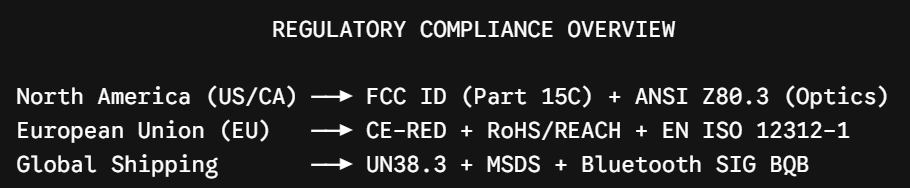
1. United States Market Requirements (FCC & FDA)
To legally sell wireless smart eyewear in the US, devices must pass radio frequency and optical safety standards:
FCC Part 15C Certification (FCC ID): Mandated for all intentional Bluetooth radiators. Tests electromagnetic interference (EMI) and RF exposure limits (SAR testing).
FDA Impact Resistance (21 CFR 801.410): Lenses must undergo the Drop Ball Test (a 5/8-inch steel ball dropped from 50 inches) to ensure impact safety.
ANSI Z80.3 Compliance: Ensures non-prescription sunglasses meet UV protection and optical clarity guidelines.
2. European Union Market Requirements (CE RED, RoHS & REACH)
The European Union enforces comprehensive environmental and radio regulations:
CE RED (Radio Equipment Directive 2014/53/EU): Covers safety (EN 62368-1), EMC (EN 301 489), and RF spectrum efficiency (EN 300 328).
RoHS Directive (2011/65/EU): Restricts heavy metals (lead, mercury, cadmium) in PCBA solder and internal wiring.
REACH SVHC Compliance: Ensures materials coming into direct contact with skin (TR90 frame, nose pads) are free from harmful phthalates or chemical sensitizers.
3. Battery Safety & Air Freight Logistics (UN38.3 & MSDS)
Batteries embedded in glasses frames are subject to strict dangerous goods transportation rules:

UN38.3 Transport Testing: Mandatory for shipping lithium batteries by air or sea. Evaluates battery response to altitude, vibration, impact, and thermal shock.
MSDS (Material Safety Data Sheet): Required by freight forwarders for air transport clearance.
IEC 62133-2: International safety standard for sealed rechargeable lithium cells used in portable equipment.
4. Bluetooth SIG Qualification (BQB Licensing)
Any product utilizing Bluetooth technology and displaying the Bluetooth® logo must hold a valid Bluetooth Qualification Design (QDID).
Importing uncertified Bluetooth hardware exposes brands to trademark enforcement and potential market removal.
Our factory holds valid Bluetooth SIG End Product listings, allowing white-label partners to reference our QDID and simplify their own compliance filings.
Comprehensive Sourcing Compliance Matrix
| Regulatory Body | Standard / Test | Scope / Purpose | Required for Clearance |
| FCC (USA) | Part 15 Subpart C | RF Emissions & Wireless Safety | Yes |
| EU CE | RED 2014/53/EU | Health, Safety, EMC, Radio | Yes |
| UN (Global) | UN38.3 / MSDS | Battery Air Freight Safety | Yes |
| RoHS / REACH | 2011/65/EU | Chemical / Material Safety | Yes |
| Bluetooth SIG | BQB Listing | Bluetooth Trademark Licensing | Yes |
🛡️ Need verified compliance files for your customs broker?
All our export models are fully certified with official lab reports available for immediate review.
📩 [Download Our Complete Test Reports & QDID Compliance File]