Sourcing consumer electronics overseas involves real commercial risks. Importers often receive high-performing prototypes, only to encounter battery degradation, high return rates, or certification delays when mass production units ship.
When sourcing smart glasses, standard electronics inspection checklists are insufficient. Smart eyewear must adhere to both consumer electronic standards and eyewear safety norms.
Here is a 7-step inspection checklist every procurement manager should run before placing a volume production order.
The 7-Point Audit Framework
FACTORY AUDIT CHECKLIST FOR SMART EYEWEAR
1、 Battery Safety (UN38.3/IEC62133)
2、Hinge Stress & Flex Testing
3、Acoustic Isolation Chamber Check
4、ESD & Thermal Shock Stability
5、Optical & Lens QC
6、 RF & EMC Compliance
7、IPX Rating Testing
Step 1: Verify Battery Safety and International Compliance
Smart glasses place lithium batteries directly adjacent to the user's temples. Regulatory compliance is non-negotiable:
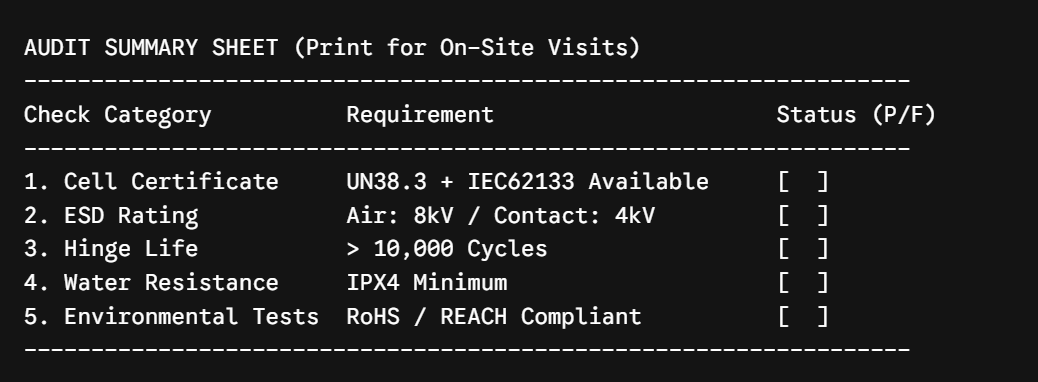
Demand certified test reports for UN38.3 (air transport safety), MSDS, and IEC 62133 battery cell safety.
Ensure the battery management system (BMS) includes overcharge, over-discharge, short-circuit, and thermal cutoff protections.
Step 2: Hinge Fatigue and Structural Stress Testing
Eyewear is constantly opened, closed, and flexed during daily wear.
Inspection Rule: Ask the supplier for their automated hinge testing records. A reliable factory should test hinges to at least 10,000 cycles at a flex angle of 15° beyond normal opening position.
Step 3: Acoustic Isolation and Mic Beamforming Verification
Do not rely on quiet office tests. Test prototypes in real-world ambient noise environments (such as coffee shops or high-traffic areas).
Ensure dual-mic ENC reduces background noise by at least 25dB – 30dB during voice calls.
Check sound leakage at arm's length (approx. 50cm) at 70% volume.
Step 4: Lens Safety and Frame Material Standards
Material Safety: Frame materials must meet RoHS and REACH hazardous substance requirements to prevent skin irritation upon prolonged contact.
Optical Safety: Tac polarized or polycarbonate UV400 lenses must satisfy ANSI Z80.3 (USA) or EN ISO 12312-1 (EU) optical clarity standards.
Step 5: Electrostatic Discharge (ESD) and Environmental Shock
Static electricity from human hands can destroy exposed charging pins if the circuit protection is poorly designed.
Confirm that exposed pogo pins or USB-C ports can withstand ±8kV air discharge and ±4kV contact discharge without system reset or damage.
Step 6: IP Water Resistance Verification
Sweat and rain are primary causes of field returns in wearable gear.
Inspect the factory's IP water-testing booth. Verify that units tested under IPX4 or IPX5 conditions continue to function after 24 hours of drying time.
Step 7: Factory Capacity and Supply Chain Traceability
Finally, evaluate operational capacity:
SMT Capacity: Does the factory operate in-house SMT surface mounting lines, or do they outsource PCBA assembly? In-house SMT ensures stricter quality control.
Traceability: Does every PCBA carry a unique QR/Bar code label for tracking batch production data?
Downloadable B2B Audit Summary Sheet
📋 Need verified factory certifications for your compliance team?
All our products are CE, FCC, RoHS, and TELEC certified with complete lab test reports available.
📩 [Download Our Full ISO9001 & Compliance Inspection Certificates]